Sunday, 24 May 2020

Seed by Joanna Walsh


Last Friday night A Leap in the Dark featured the author Joanna Walsh in conversation with her publisher Emma Warnock of the excellent Belfast-based. independent No Alibis Press. www.noalibispress.com 

Joanna generously provided this note introducing a short passage from Seed, as follows:

Seed is a story told in the voice of a teenage girl, isolated in industrial countryside at the end of the 1980s. When I wrote Seed I spent a lot of time thinking about what a voice is and what a character is, and I ended up thinking that a character can be many voices: porous voices sliding into each other, coming out of their environment, the body, and the words they read and hear around them every day. Here's a little piece of my book, 'Seed'. I hope you'd like to be one of the voices of Seed and read it together with me.

"SENTENCE

I am working toward a sentence that can say everything at once. I think I can make one but not yet about the valley and the town all in the same sentence and about now and about what has been everything I remember and what the valley remembers a sentence that takes into account each blade of grass—yes the topside that flashes white and the underside that is deep blue the smell when you walk on it—and the same for all the stems of wheat that catch the sun all together like they’re one thing like a giant metal monster and the fields at all the times of year all together the fields liquid green the gold the stubble that sticks out of the ground the straw on the roads the smell of fields burnt thick like tar hanging in the air their colour deeper than anything still not black as nothing’s black in nature only words and there is no need for prepositions because everything is at the same time and in the same place there are lots of verbs lots of doing words but layered on top of each other like people all speaking at once. It is like how time crosses the valley like the wind that puts its shape into things always everywhere at the same time like what I said about the shape in the settee I mean sofa I mean it’s invisible but is the past and the present at the same time.

It takes less than one second to say.
I do not know how long it takes to write.

I can’t make any sentence about the future. I don’t know if I can make one about anything outside the valley."


What happened on the night I'll remember for a long time

Around thirty members of the audience, all in lock-down and scattered over the planet, joined together reading the passage aloud, simultaneously but at different speeds. It was an uncanny, moving experience. Through headphones (and these are recommended on Zoom to cut down on reverb and feedback) the effect was immersive, a throb and murmur of voices inside one's head, some familiar, some not, coupled with one's own. Like being part of a hive mind, or at least a community with a shared purpose. It was both communal and isolating. It was wonderful.

Saturday, 23 May 2020

A Leap in the Dark: Saturday 23rd May


A Leap in the Dark 16    8pm Saturday 23rd May 2020


Tonight’s Leap is about translation, both musical and textual. 

Helen Ottaway will premiere her modification of Beethoven’s Ode to Joy and (later) translate one of her compositions from harpsichord to piano. Distinguished translators Frank Wynne and Daniel Hahne will lock linguistic horns in a translation slam; the poet Astrid Alben will talk us through the translation of syntactical illusions, Aea Varfis-van Warmelo  and David Collard will perform Apollinaire’s great modernist poem Zone in French and English and Aea will also offer some thoughts on poetry in translation.

There's no charge for taking part but please make a donation, no matter how large, to The Trussell Trust or your local equivalent outside the UK.


The Programme


1 Welcome from the Pale Usher

2 Beethoven’s Ode to Joy, a musical box strip modified by Helen Ottaway 

3 Translation slam with Frank Wynne and Daniel Hahne


Interval 


4 Helen Ottaway performs ‘Dove’, the 4th movement of her ‘Suite of Somerset Apples’ 

Helen writes: 

Dove is a cider apple from the Glastonbury area. Last year I arranged this piece for 2 cellos and it was performed in a cider orchard very near Glastonbury. The original is for 2 high sweet registers of the double manual harpsichord, the lute stop on one manual and the 4’ stop on the other.  The parts played by the two hands are played in the same register – something tricky and not so successful if attempted on the piano.  So on Saturday I will transpose the lower part down an octave - a musical translation from harpsichord to piano.

5  Astrid Alben: Bridge or Banana - translating syntactical illusions

6 ‘Zone’ by Guillaume Apollinaire. A new translation performed by Aea 
   Varfis-van Warmelo and David Collard

7 Apollinaire’s ‘l’Avenir’ performed in French and English by Aea Varfis-
  van Warmelo

8 The Pale Usher signs off


The Company


Astrid Alben is a poet and translator. Astrid translates contemporary, experimental poetry from the Dutch and Flemish. Her translations are published in MPT, Jacket, Poetry International Rotterdam, Versopolis, Poetry Review and Poem. She is the translator of F. van Dixhoorn and the Dutch Poet Laureate Anne Vegter. Her latest collection is Plainspeak, published by Prototype in 2020.

Daniel Hahne is a writer, editor and translator, with some seventy books to his name. His work has won him the International Dublin Literary Award, the Blue Peter Book Award, the Independent Foreign Fiction Prize and has been shortlisted for the Man Booker International Prize, among others. He is a past chair of the Society of Authors, and the trustee of a number of organisations that work with literature and free expression.

Michael Hughes is the author of two acclaimed novels: Countenance Divine (2016) and Country (2018) both published by John Murray, the latter winning the 2018 Hellenic Prize. Under his stage name Michael Colgan he recently appeared in the acclaimed HBO television drama Chernobyl.

Helen Ottaway is a composer and sound artist. She is lead artist with Artmusic, creating and producing collaborative, site-specific art work. She has written for many forces from string quartet to choir and orchestra and recently has started to include found sound in her work. Her writing for hand-punched and hand-wound musical box began during an artist’s residency in Sri Lanka in 2017. Back in the UK she continues to compose for and perform on the instrument.  
www.artmusic.org.uk   https://helenottaway.bandcamp.com/

Aea Varfis-van Warmelo is a trilingual actor and writer.

Frank Wynne is a literary translator. Born in Ireland, he  moved to France  in 1984 where he discovered a passion for language. He worked as a bookseller in Paris and again when he moved to London  in 1987. He translated and published comics and graphic novels and from 1996-2001 he worked in online media.

He began translating literature in the late 1990s, and in 2001 decided to devote himself to this full time. He has translated works by, among others, Michel Houellebecq, Frédéric Beigbeder, Ahmadou Kourouma, Boualem Sansal, Claude Lanzmann, Tómas Eloy Martínez and Almudena Grandes. His work has earned him a number of awards, including the  Scott Moncrieff Prize and the Premio Valle Inclán. His translation of Vernon Subutex was shortlisted for the Man Booker International 2018 and his translation of Animalia by Jean-Baptiste de Amo won the 2020 Republic of Consciousness prize. His website is www.terribleman.com

The Pale Usher is David Collard, who organises these gigs.

The pale Usher—threadbare in coat, heart, body, and brain; I see him now. He was ever dusting his old lexicons and grammars, with a queer handkerchief, mockingly embellished with all the gay flags of all the known nations of the world. He loved to dust his old grammars; it somehow mildly reminded him of his mortality.
  Moby-Dick by Herman Melville


Our next Leap in the Dark is on Friday 29th May and will feature 


- music from composer Helen Ottaway  

- canto XI of Spring Journal by Jonathan Gibbs, read by Michael Hughes

- another yoga session with David ‘Guru Dave’ Holzer

- ‘The Binding Problem’ with psychologist and author Hugh Fulham-McQuillan 
   of Trinity College Dublin in conversation with novelists Kevin Davey 
   and Eley Williams

- Letter from Mexico City by Paulette Jonguitud


Please remember to make a donation to The Trussell Trust (or your local equivalent). Thank you.


Stay well!


The Pale Usher 


Friday, 22 May 2020

A Leap in the Dark: Friday 22nd May

A Leap in the Dark 15    8pm Friday 22nd May 2020


This evening’s Leap features the author Joanna Walsh (Hotel, Vertigo and Worlds from the Word’s End) discussing her forthcoming novel Seed with Emma Warnock of the Belfast-based No Alibis Press. Novelist Kate Armstrong delivers A Letter from London and we’ll have another yoga lesson from David ‘Guru Dave’ Holzer. There’s the latest, keenly-anticipated canto of Spring Journal by Jonathan Gibbs, read as usual by Michael Hughes, who will later join two other writers from Northern Ireland - Wendy Erskine and Emma Devlin - for the Settee Salon. 

There's no charge for taking part in A Leap in the Dark, but please make a donation, no matter how large, to The Trussell Trust.


The Programme


1 Welcome from the Pale Usher

2 Spring Journal canto X by Jonathan Gibbs, read by Michael Hughes

3 Joanna Walsh in conversation with Emma Warnock

4 Letter from London by Kate Armstrong


Interval 


5 Yoga with David ‘Guru Dave’ Holzer

6 The Settee Salon with Emma Devlin, Wendy Erskine and Michael Hughes

7 Another yoga session with 'Guru Dave' 

9 The Pale Usher signs off


The Company


Kate Armstrong was born in Crewe and grew up in Yorkshire. Her first novel The Storyteller was published by Holland House Books in 2016 and was longlisted for the Republic of Consciousness Prize. She is currently working on a memoir about mental collapse, recovery, and Himalayan climbing, tentatively called Beyond The Mountain.  

Emma Devlin is a graduate of Queen’s University Belfast. Her work has featured in Blackbird and The Bangor Literary Journal. She can be found on Twitter: @theactualemma

Wendy Erskine is the author of Sweet Home, an acclaimed debut collection of short stories originally published by Stinging Fly in Ireland and later by Picador.

Michael Hughes is the author of two acclaimed novels: Countenance Divine (2016) and Country (2018) both published by John Murray, the latter winning the 2018 Hellenic Prize. Under his stage name Michael Colgan he recently appeared in the acclaimed HBO television drama Chernobyl.

Jonathan Gibbs is a writer and critic. His first novel, Randall, was published in 2014 by Galley Beggar, and his second, The Large Door, by Boiler House Press last year. He has written on books for various places including the TLS, Brixton Review of Books and The Guardian. He curates the online short story project A Personal Anthology, in which writers, critics and others are invited to 'dream-edit' an anthology of their favourite short fiction. Spring Journal is a response to the current coronavirus pandemic taking its cue very directly from Louis MacNeice's Autumn Journal.

David Holzer is a dedicated yogi, author, blogger and journalist. He founded YogaWriters (www.yogawriters.org) and has taught workshops in yoga for writers in Mallorca, where he lives. Hundreds of people have taken his Yoga for Writers course on the DailyOm platform. His writing appears regularly in Om yoga and lifestyle magazine.

Each Friday David will be taking us through a simple yoga sequence that can be done by anyone of any age in the comfort of a favourite chair.

Disclaimer

Please take care when practicing yoga. Should a pose feel that it could be harmful to you, do not attempt it or come gently out of the pose.

Breathing is a key part of yoga. Please breathe comfortably and naturally through your nose at all times. If your breath becomes forced, slow down the speed of your practice.

If you feel any kind of sharp, sudden pain anywhere in your body stop practicing right away. Be especially aware of your joints, particularly your knees.

Joanna Walsh is an internationally-published writer of fiction and creative nonfiction. She is also a critic (The Guardian, The New Statesman, Los Angeles Review of Books), and an editor at 3:AM Magazine and gorse editions. She was a judge on the 2016 Goldsmiths Prize and won the Arts Foundation Award for Creative Non-fiction in 2017. She founded @read_women. She is the author of Vertigo, Hotel, Fractals, Grow A Pair, Worlds From The Word’s End and the digital work Seed-story.com. Her ‘novel in essays’ Break.up was published in the UK by Tuskar Rock Press and in the US by Semiotext(e) in Spring 2018.

Emma Warnock is the editor at No Alibis Press, a small and relatively new independent publisher of fiction based in Belfast and founded by David Torrans, owner of No Alibis Bookstore. 2020 publications are Seed by Joanna Walsh and a new collection from Ian Sansom. Information about publications, episodes of podcasts and videos, and contact details are available at: www.noalibispress.com

The Pale Usher is David Collard, who organises these gigs.

The pale Usher—threadbare in coat, heart, body, and brain; I see him now. He was ever dusting his old lexicons and grammars, with a queer handkerchief, mockingly embellished with all the gay flags of all the known nations of the world. He loved to dust his old grammars; it somehow mildly reminded him of his mortality.
  Moby-Dick by Herman Melville


Tomorrow night we’’ll have some fine music by our regular contributor Helen Ottaway and we’re delighted to welcome back the distinguished translator Frank Wynne (who appeared in our very first Leap). Frank will be in conversation with his fellow translator Daniel Hahne and together they’ll engage in something new to me - a translation slam. They’ll both tackle a passage in French chosen by The Pale Usher’s son, talking us through the process. The audience will vote on which version they prefer. 

We’ll also have Apollinaire’s great modernist poem Zone, performed by Aea Varfis-Van Warmelo in a new translation by David Collard. (Originally delivered in a real-world performance a lifetime ago, on 29th February - Leap Year night.) And after that some thoughts from Aea on the business of translating poetry.


Please remember to make a donation to The Trussell Trust (or your local equivalent)


Stay well!


The Pale Usher 


Thursday, 21 May 2020

On Joanna Walsh and Hitchcock

This blog comes with a flimsy pretext.

Prompted by the imminent appearance of the writer Joanna Walsh on tomorrow night's A Leap in the Dark, I dug up this unpublished blog about the novel on which Alfred Hitchcock based his great film Vertigo. Because Joanna wrote a novel with the same title. Vertigo, I mean. So, come to that, did W. G. Sebald. But he's not a guest on A Leap in the Dark.

Joanna will be in conversation with Emma Warnock of the Belfast-based No Alibis Press, about her forthcoming novel Seed. Invitees will receive an exclusive extract and introductory note from Joanna in the morning. 
-----------------------------------------------------------------------------------------------------

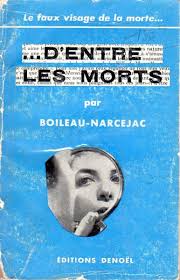
D'entre les Morts is a modestly competent psychological thriller by the French writing duo known as Boileau-Narcejac, first published in 1954. It's fair to say that it would attract little attention today had it not formed the basis of Alfred Hitchcock's Vertigo. The novel was recently republished in English, and I was delighted to be given the chance to review it, because the film has been a personal obsession since I saw a faded print screened in a Manchester flea-pit nearly forty years ago. After multiple viewings it remains as fresh and complex and alluring as ever, one of a handful of films that deserve and repay close attention over decades. It is an undisputed masterpiece, although on its release in 1958 the director's forty-fifth feature met with a lukewarm reception and would not appear in the Sight & Sound critics' poll until 1982, when it came seventh. In the most recent poll it was voted the greatest film of all time, displacing Citizen Kane, which had occupied the top spot since the poll began fifty years ago. Such lists count for little, but if pushed I'd argue that Hitchcock is a greater director than Orson Welles while Welles is the greater artist. This is the kind of distinction that used to prompt heated exchanges in the bar of the old National Film Theatre, spiritual home to many a passionate cineaste.


Reading the novel, one experiences (as I note in my TLS review) an unnerving sense of déjà lu, because although the setting is Paris and Marseilles before and after the German Occupation, the premiss is immediately familiar: a wealthy industrialist employs an ex-cop to keep an eye on his troubled wife, Madeleine, who appears to be possessed by the spirit of a dead ancestor. The cop soon becomes infatuated with her, attracted by her chilly glamour and aura of sadness, and when he witnesses her apparent suicide he becomes a melancholy, deracinated alcoholic. He later encounters another woman, appropriately named Renée, who appears to be Madeleine's double, her reincarnation. He attempts obsessively to re-make her in the image of his dead lover, scrupulously selecting her outfits, jewellery, make-up and hair (women's hair is a recurring motif in Hitchcock's oeuvre).
Vertigo is an intensely romantic film, but also profoundly morbid. There's a whiff of necrophilia in the movie, and considerably more than a whiff in the novel, where even Madeleine's perfume, Chanel No. 3, is headily redolent of “fresh earth and wilting flowers”. The besotted cop single-mindedly pursues his fantasy, described bluntly by Hitchcock in an interview with François Truffaut thus: “He wants to sleep with a dead woman”.
The director's perverse genius extended beyond a transgressive modern take on the Eurydice myth to explore themes of power and freedom; the power of men over women, of human beings over their fate and our dreams of freedom from death. Hitchcock wasn't especially interested in the mechanics of plotting, and audaciously gave the secret away thirty minutes before the end of the film in a combination of flashback and voiceover. What interested him – and what makes the film a timeless pleasure – is the human dilemma, the dreamy mutability of Kim Novak, who delivers one of cinema's greatest performances.
Later in the Truffaut interview Hitchcock also said: “Some films are a slice of life. Mine are a slice of cake”. Surely what he intended to say – and quite possibly said, using an idiom lost in translation – was: “Some films are a slice of life. Mine are a piece of cake. This casual dismissal of his astonishing virtuosity served to deflect attention from the private obsessions and fears that he smuggled on to the screen, for a popular audience hungry for distraction, sensation and entertainment.

Wednesday, 20 May 2020

A Verlaine translation


From 2013, an old blog following another insomniac night. This Saturday's Leap in the Dark (23rd May) is dedicated to translation, so ahead of that here's my two penn'orth:


An insomniac night, so here's a Verlaine translation made (appropriately) during a rainstorm. Am reading his collection Sagesse at the moment, verses he wrote following his release from Mons prison where he served 18 months for shooting and wounding his lover Rimbaud.


He came to England in March 1875 and found employment teaching French, Latin and drawing at a village school in a Lincolnshire backwater called Stickney. He moved after a year to another school in cosmopolitan Bournemouth, returning to Paris in 1877, there to be lionised to death. I'm currently researching Verlaine's two years in England because while his hectic three months' residence with Rimbaud in Camden Town is well-known, the later period in Stickney and Bournemouth is not, although it saw him write some of his best poetry. Here's a sample, with my translation:


Il pleure dans mon coeur
Comme il pleut sur la ville.
Quelle est cette langueur
Qui pénêtre mon coeur ?

O bruit doux de la pluie
Par terre et sur les toits !
Pour un coeur qui s’ennuie,
O le chant de la pluie !

Il pleure sans raison
Dans ce coeur qui s’écoeure.
Quoi ! nulle trahison ?
Ce deuil est sans raison.

C’est bien la pire peine
De ne savoir pourquoi,
Sans amour et sans haine,
Mon coeur a tant de peine.


It rains in my heart
As it rains on the town,
What is this languor
That so soaks my heart?

Oh sweet sound of rain
On earth and on roof.
For my dumb heart again,
This song of the rain.

Rain for no reason
In a heart lacking heart.
What? Without treason?
This grief without reason.

By far the worst pain,
That I cannot explain
Without love, without hate,
That my heart is all pain.

Monday, 18 May 2020

A Zoom with a View

Saturday night's Leap in the Dark, curated by author and publisher Nicholas Royle (Manchester), was dedicated to prose, with a fine line-up of writers appearing in his Nightjar Press imprint

We had a lock-in afterwards during which a few die-hards picked the bones out of Thomas the Tank Engine, clergymen trainspotters, John Donne, Henry James, (unrelated to the Sodor fleet), Henry James's suitcase and so on, until very late. As The Pale Usher I couldn't go the distance, but the conversation was still flowing when I checked out. It's the first time I've assigned hosting to another person and I feel this could be a thing in the future. The party can continue after the host has left, although I need two think about the potential security angle - the so-called 'threats cape'.

There have been some shocking incidents recently in which online events run with the Zoom app (and other apps) have been targeted by hackers, as described in this Guardian report.

So I thought I'd mention some of the security measures in place for A Leap in the Dark, the twice-weekly gathering of creative types which, as The Pale Usher, I organise and host. This is by way of reassurance for members of the Company and the audience.

The measures include, but are not restricted to, the following:

- each one-off event has a unique link to be used just once, in conjunction with a unique password, also used just once

- the link and password are sent only to members of the Company and invitees who are personally known to me and whose names are on a guest list finalised at 5pm on the day of the show

- the link and password are sent to the  invitedaudience 15 minutes before each event begins at 8pm, allowing invited guests to log on and assemble in the virtual waiting room. Contributors get a slightly earlier invitation at 7:30pm so they can mingle in the virtual Green Room

- I never use my personal ID (which would allow uninvited users to access our gathering)

- as the host I control admission to the gathering on a one-to-one basis (I do not 'admit all' with a single click); nobody unknown to me is admitted unless they are fully accredited and on the guest list agreed in advance

- these events are not, and never will be, open to the general public. The number of places is capped and other security measures are in place

- members of the core audience are automatically invited each week to the Friday and Saturday Leaps. Others are invited to specific gatherings on a one-off basis if I receive notice in advance from a sponsor known to me, and have a confirmed email address. This allows contributors to invite friends and families as guests.

- finally (and this is important) invited guests must not share the unique link and password with anybody else. I understand why  contributors in particular would like their friends and family to be in the audience, but please make it clear that they should not share the link and password with any third party, because if their name isn't known to me I shan't admit them on the night (with apologies).

That's as safe as I can make it.


Sunday, 17 May 2020

About last night


Two more Leaps in the Darl, on Friday and Saturday night. The first was mostly poetry,. Along with appearances from regulars Jonathan Gibbs and Michael Hughes, and a conversation with and reading by novelist Simon Okotie, we had four wonderful performances from Astrid Alben (in London), Rhys Trimble (Bethesda), Christodoulos Makris (Dublin) and Matthew Welton (Nottingham).

Here are links to some of Astrid's publications, including her first two very fine collections, which are recommended. She has a cool and supple style which constantly surprises and engages. I expect to be wrong-footed by the best poetry and Astrid's work does just that.


Rhys Trimble's excellent  and expansive website is a seam both rich and strange, and well worth exploring for texts and performances and no end of other good things.

Christodoulos Makris is the author of This is No Longer Entertainment published by Dostoyevsky Wannabee Press) and here's a very good piece nay him in The Irish Times.

And finally Matthew Welton's latest collection is Squid Squad, published last week by Carcanet and recommended. His choice of poems was randomised by numbered ping-pong balls expertly chosen by Amy (I hope I caught her name correctly). Top-notch entertainment!

Last night's Leap, curated by author and publisher Nicholas Royle (Manchester), featured a fine line-up of writers appearing in his Nightjar Press imprint. You can see what you missed, or recall what you saw, here. It was a marvellous evening with many new faces in the audience who will (I hope) join us again for future Leaps.

We had an unplanned lock-in afterwards during which a few die-hards picked the bones out of Thomas the Tank Engine, Henry James, (unrelated to the other engines in the Sodor fleet), Bill Cosby clergymen trainspotters, John Donne and so on, until very late. It was still going strong when I checked out (and will, I think, be a feature of future Leaps, although with limited participation from The Pale Usher, who needs his twelve hours of sleep or he's a wreck the following afternoon.

Next week's Leaps will feature (on Friday) writers Joanna Walsh, Michael Hughes, Emma Devlin and Wendy Erskine and usual features (Spring Journal, David Holzer's yoga lesson) and (on Saturday) a translation slam with Frank Wynne. And other stuff.